

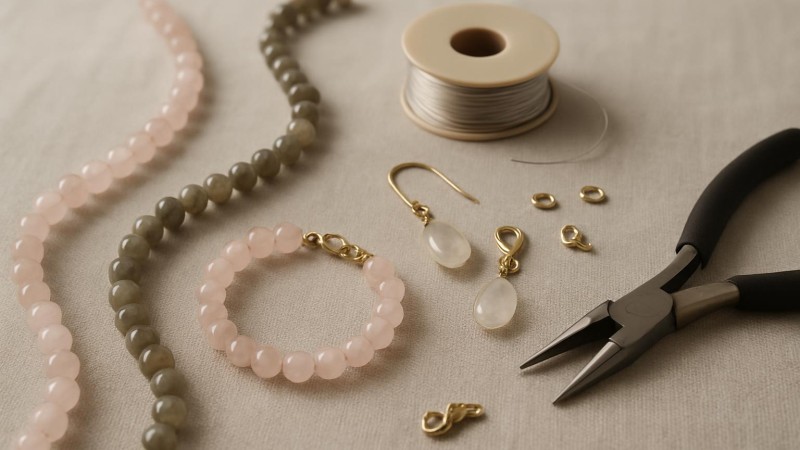
Jewelry making is both an ancient craft and a practical modern skill: a way to turn stone, metal, cord, and imagination into objects that can be worn every day. A simple bracelet may begin with a handful of beads, but the techniques behind it touch on design, engineering, material science, hand skill, and finishing. The difference between a beginner project and a professional-looking piece is rarely one secret trick. It is the accumulation of small decisions: the right cord, the right loop, the right clasp, the right tension, and the patience to finish cleanly.
This comprehensive guide is designed as a true starting point and a long-term reference. If you are new, it will help you understand what to learn first, what tools matter, and how to avoid the most frustrating mistakes. If you already make jewelry, it will help you connect techniques across stringing, wirework, bead weaving, findings, cold connections, basic metalwork, surface finishing, design, sizing, and studio workflow. The goal is not to rush you through one project, but to give you a map of the craft.
Because PebbleBead focuses on natural stone jewelry, gemstone beads, findings, and jewelry-making supplies, this guide pays special attention to material behavior. Gemstones are beautiful, but they vary in hardness, hole size, weight, shape, polish, and durability. A technique that works perfectly for lightweight glass beads may not be right for large stone beads, and a delicate wire wrap may need adjustment when paired with heavier components. Understanding those differences helps your jewelry last longer and look more intentional.
Use this pillar guide as your foundation. Read it front to back if you want a structured overview, or return to individual sections when a project raises a question. You will learn what each major technique is for, when to choose it, which tools and supplies are involved, how professionals think through construction, and how to troubleshoot weak points before they become broken pieces.
Table of Contents
- Jewelry Making Foundations
- Materials, Beads, and Gemstones
- Essential Tools and Studio Setup
- Stringing, Stretch, and Knotting Techniques
- Wirework and Wrapped Loops
- Findings, Clasps, and Cold Connections
- Bead Weaving and Seed Bead Techniques
- Metalwork, Soldering, and Texture
- Design Principles, Fit, and Wearability
- Finishing, Care, Troubleshooting, and Pro Workflow
- Frequently Asked Questions
- Conclusion
Jewelry Making Foundations
What jewelry making really includes
Jewelry making is not one technique; it is a family of related skills. Bead stringing, wire wrapping, chain assembly, metal forming, knotting, bead weaving, soldering, riveting, polishing, and stone setting can all belong under the same umbrella. Many makers begin with simple strung bracelets because the materials are approachable and the results are immediate, but the craft expands quickly. Once you understand tension, balance, connection points, and finishing, you can apply those ideas to necklaces, earrings, charms, pendants, anklets, and more complex statement pieces.
A strong foundation starts with the purpose of the piece. A necklace meant for daily wear needs different construction than a dramatic photo-shoot design. Earrings must consider weight and movement. Bracelets experience more abrasion than most jewelry because they rub against desks, sleeves, bags, and tabletops. Rings endure even more impact. Before choosing a technique, ask how the piece will be worn, how often it will move, and where stress will concentrate.
The three pillars: structure, surface, and style
Every successful piece of jewelry balances structure, surface, and style. Structure is the hidden engineering: cord strength, wire gauge, knot security, clasp choice, and connection integrity. Surface is what the wearer sees and touches: polished gemstones, smooth metal edges, even wraps, clean thread paths, and consistent tension. Style is the design language: color, rhythm, scale, contrast, symbolism, and mood.
Beginners often focus on style first because beads are visually exciting. That enthusiasm is valuable, but structure should never be an afterthought. Heavy amethyst beads may look beautiful on a delicate cord, yet the finished bracelet will fail if the cord is not suitable for the bead weight and hole finish. A professional maker learns to enjoy both the visible design and the invisible construction.
Learning sequence for beginners
The most efficient learning path moves from simple, forgiving techniques to precise, permanent ones. Start with basic stringing so you learn sizing, bead layout, crimping, and clasp attachment. Add stretch bracelets to understand elasticity, knot placement, and tension. Move into simple wire loops, then wrapped loops, then linked components. After that, explore bead weaving, knotting between beads, cold connections, and finally heat-based metalwork if your workspace allows it.
A useful beginner sequence looks like this:
- Make a simple strung bracelet using flexible beading wire and a clasp.
- Make a stretch bracelet with correctly seated knots and suitable bead weight.
- Create earrings using head pins, simple loops, and ear wires.
- Practice wrapped loops until both sides look consistent.
- Design a necklace that combines chain, beads, and a focal pendant.
- Try a small bead weaving sample to build thread tension control.
Common early mistakes
Most early mistakes are predictable and easy to correct. New makers often use the wrong tool for the job, choose cord that is too thin, cut wire with worn cutters, make loops that are not fully closed, or forget to test the clasp before wearing. Another common problem is overloading a design with too many focal elements. The eye needs resting places, just as the construction needs reliable stress points.
The best habit is to inspect every piece before calling it finished. Tug gently on connections, run your fingers over wire ends, check that beads move as intended, and look at the design in natural light. Good jewelry making is partly creativity and partly quality control. When you build those habits early, every advanced technique becomes easier.
Materials, Beads, and Gemstones
Understanding bead materials
The material you choose determines not only the look of a piece but also its construction requirements. Natural stone beads are typically heavier than acrylic, resin, or many glass beads. Metal beads can add elegance, but they may also change the balance of a necklace or increase abrasion on soft cord. Wood, bone, ceramic, shell, and pearl each have their own personality, texture, and durability profile. The more you know about a material, the better you can choose techniques that respect it.
Gemstone beads vary widely. A round polished bead behaves differently from a faceted rondelle, a chip bead, or a large nugget. Smooth rounds are often comfortable and easy to string, while faceted edges can sparkle but may rub against thread or softer neighboring beads. Irregular stones bring organic character, yet they require extra attention to spacing, hole alignment, and symmetry. A strand of freshwater pearls may call for gentle knotting and careful handling, while dense stone beads may need stronger wire or cord.
Hardness, holes, weight, and finish
Gemstone hardness is often discussed using the Mohs scale, but jewelry makers should think beyond hardness alone. A stone can be hard yet brittle, or soft but protected by a rounded shape and smooth polish. Hole quality matters greatly. A sharp or gritty bead hole can cut thread, fray cord, or weaken elastic over time. Before stringing valuable or heavy beads, pass a small section of cord through several beads and check whether it snags.
Weight is another major factor. Large gemstone beads create a luxurious feel, but they increase strain on crimps, jump rings, and clasps. Lightweight designs can use finer findings, while heavier necklaces need sturdier connections and often benefit from larger clasps for ease of use. Finish affects both appearance and wear. Matte stones have a softer, earthy presence but may show oils sooner; high-polish beads reflect light and can make colors appear deeper.
Natural stone meaning and cultural context
Many makers enjoy the traditional symbolism of gemstones. In folklore, amethyst has often been associated with clarity and calm, turquoise with protection, rose quartz with affection, and jasper with grounding. These meanings are cultural and historical beliefs, not medical facts or guarantees. When writing product descriptions or gifting jewelry, it is best to frame such associations respectfully as tradition, symbolism, or personal intention.
That symbolism can still be powerful in design. A bracelet using hematite beads may feel sleek and modern because of its metallic gray color, while also carrying traditional associations with strength in some beadwork communities. A moonstone necklace may suggest softness and light because of the stone's glow. Meaning becomes part of the story, but construction remains the maker's responsibility.
Choosing beads for technique
Match the bead to the method. Small uniform beads suit bead weaving because consistency supports clean patterns. Larger stone beads work well in simple stringing, focal pendants, and wire-wrapped links. Very delicate beads should be protected from hard metal edges, and beads with tiny holes may require fine wire, thin thread, or a different design. If the hole is too small for the strongest material you need, do not force it; redesign the piece or choose a more appropriate bead.
For planning, lay out beads before cutting any material. Check color flow, size progression, and hole orientation. Mix matte with glossy, opaque with translucent, and small spacers with larger stones to create rhythm. The best material choices feel beautiful, function reliably, and support the intended technique rather than fighting it.
Essential Tools and Studio Setup
The core tool kit
A beginner does not need a large studio, but good basic tools make a noticeable difference. The essential kit includes round-nose pliers, chain-nose pliers, flat-nose pliers, flush cutters, a bead mat, measuring tape, bead stoppers, crimping pliers, and a good light source. Add a ruler marked in both inches and centimeters, small storage containers, and a tray to keep rolling beads under control. Quality tools are easier on your hands and produce cleaner work.
Each plier has a purpose. round-nose pliers form loops and curves, but they are not ideal for gripping flat surfaces. Chain-nose pliers grip, tuck wire ends, open jump rings, and reach into tight spaces. Flat-nose pliers hold wider surfaces and help straighten wire. Flush cutters make clean cuts when used correctly, with the flat side facing the part of the wire you want to keep. Using the right tool prevents dents, uneven loops, and sharp unfinished ends.
Workspace organization
A productive jewelry workspace can be small, but it should be stable and well organized. A bead mat prevents beads from rolling, softens the work surface, and helps colors show accurately. Good lighting reduces eye strain and makes it easier to see wire ends, knot placement, and thread paths. Keep frequently used tools within reach, but avoid crowding the work area. A cluttered table increases the chance of lost beads and accidental scratches.
Storage should separate materials by type and size. Keep gemstones away from rough metal tools that might scratch softer surfaces. Store findings in labeled compartments so you can quickly compare finishes, gauges, and sizes. Thread, cord, and wire should be protected from kinks, moisture, and dust. When you can see your materials clearly, design decisions become faster and less stressful.
Tool care and safety
Jewelry tools last longer when they are used as intended. Do not cut memory wire with standard flush cutters; it can damage the cutting edge. Keep plier jaws clean, especially when working with patinas, adhesives, or soft metals. If a tool develops burrs, it can mark wire or scratch beads. Many makers keep one set of cutters for fine precious metal wire and another for harder craft wire.
Safety matters even for simple techniques. Trimmed wire ends can fly, so point cuts away from your face and consider eye protection when cutting springy materials. Ventilate your space when using adhesives, patinas, or polishing compounds. Keep blades, needles, and small findings away from children and pets. If you later move into soldering, use a dedicated heat-safe area and learn fire safety before lighting a torch.
Supplies that support accuracy
Small accessories improve consistency. A bead board helps plan necklace lengths and symmetrical layouts. Calipers measure bead diameter, wire thickness, and hole size more accurately than a ruler. A ring mandrel, bracelet mandrel, and nylon hammer support shaping without marring metal. wire cutters should be sharp enough to cut cleanly rather than crushing wire. For bead weaving, thread conditioner, good needles, and a thread burner can make finishing easier.
Do not buy every tool at once. Build your kit around the techniques you actually practice. A stringing-focused maker needs excellent crimping tools and measuring aids, while a wire artist needs multiple plier shapes and reliable cutters. A bead weaver needs needles, thread, mats, and storage for tiny beads. Let your work guide your studio.
Stringing, Stretch, and Knotting Techniques
Flexible beading wire stringing
Stringing is one of the most accessible techniques, but it is not merely sliding beads onto a wire. Professional stringing depends on choosing the right flexible wire, planning the layout, protecting the ends, and finishing with secure crimps. Flexible beading wire is made of multiple strands of stainless steel or similar wire bundled together and coated. More strands generally mean more flexibility, while thicker diameters provide more strength. Heavy gemstones need a stronger wire than tiny lightweight beads.
The standard strung bracelet or necklace uses beading wire, crimp beads or crimp tubes, a clasp, and sometimes wire guardians or French wire for protection. The wire passes through a crimp, around the clasp loop, and back through the crimp before being compressed. Crimping pliers create a folded, secure shape rather than simply flattening the tube. A flattened crimp may look acceptable at first but can cut the wire or slip under stress.
Stretch bracelets
Stretch bracelets are popular because they are easy to wear and do not require a clasp. The challenge is durability. Use stretch cord that fits the bead holes while offering enough strength for the design. Pre-stretch the cord gently before stringing so the bracelet is less likely to loosen after wear. Avoid very heavy beads unless the elastic is strong and the bracelet is sized carefully.
The knot is the weak point in many stretch bracelets. A surgeon's knot or secure elastic knot is often used, sometimes with a tiny amount of suitable adhesive. The knot should be pulled into a bead with a hole large enough to hide it, but it should not be forced into a sharp hole that cuts the cord. Stretch bracelets should roll over the hand rather than being pulled aggressively. Educating wearers about that habit helps the piece last longer.
Knotting between beads
Knotting is a classic technique associated with pearl strands, malas, and fine gemstone necklaces. A knot between beads adds flexibility, prevents beads from rubbing directly together, and can keep beads from scattering if the strand breaks. Silk is traditional for pearls, while nylon and polyester cords are common for gemstones. The thread should suit the bead hole and the desired drape.
Consistent knotting requires practice. The knot must sit close to the bead without leaving gaps, but it should not be so tight that the strand becomes stiff. Tweezers, awls, or specialized knotting tools help place knots accurately. With irregular gemstone beads, knotting can highlight the organic spacing, but it may also exaggerate differences in bead size. Lay out the entire strand first to avoid surprises.
Crimps, covers, and common failures
Crimps are small, but they carry major structural responsibility. Choose crimp beads or tubes that match the wire diameter and clasp loop size. Too large, and the wire may slip; too small, and the crimp may not fold correctly. Crimp covers can create a polished bead-like finish, but they are decorative rather than structural. The underlying crimp must be secure before a cover is added.
Common failures include wire breaking at the clasp, crimps slipping, bracelets strung too tight, and bead holes abrading the stringing material. Leave a little movement in strung jewelry so it can bend naturally. Use bead bumpers, spacers, or protective findings when bead edges are sharp. Before finishing, flex the piece gently in a circle and check that it drapes without kinking. A clean finish is not only prettier; it is stronger.
Wirework and Wrapped Loops
Why wirework matters
Wirework is the bridge between simple assembly and expressive jewelry construction. With wire, you can create links, dangles, wrapped pendants, ear components, bead frames, spirals, cages, and decorative connectors. Unlike stringing, wirework often builds each element as a small unit. This makes it ideal for earrings, charm bracelets, rosary-style chains, and gemstone links that need visible metal structure.
The first concept is gauge. Lower gauge numbers are thicker and stronger; higher gauge numbers are thinner and more flexible. The best gauge depends on bead hole size, metal type, and function. Fine wire passes through small beads but may bend too easily. Thick wire is strong but may not fit gemstone holes. Temper also matters: dead-soft wire bends easily, half-hard wire holds shape better, and full-hard wire is more difficult to manipulate.
Simple loops versus wrapped loops
A simple loop is a basic turned loop at the end of a wire. It is quick, clean, and suitable for lightweight components that will not be pulled open. A wrapped loop adds coils around the wire stem, making a more secure and decorative connection. Wrapped loops are preferred for gemstone dangles, heavier beads, and linked designs that should not open accidentally. They also look more artisanal when done evenly.
To make a wrapped loop, string the bead onto jewelry wire or a pin, bend the wire at a right angle above the bead, form a loop with round-nose pliers, wrap the tail neatly around the stem, and trim and tuck the end. The loop should be round, centered, and large enough to move on the connecting component. The wraps should sit side by side, not piled unevenly. Consistency is more important than speed.
Head pins, eye pins, and bead links
head pins are used to create drops and dangles because the head stops the bead from sliding off. Eye pins already have a loop on one end, making them useful for links between components. You can buy them ready-made or make your own for full control over length and metal type. Making your own links is especially useful when working with mixed bead sizes or when you want a specific loop diameter.
Bead links create flexible chains of stones or pearls. The spacing between beads depends on loop size and wrap length. Tight links feel refined and dense, while larger loops create movement and a more airy look. If you are making earrings, compare both sides frequently so length and angle match. Small differences become obvious when earrings hang beside the face.
Wire wrapping stones and focals
Wire wrapping can secure beads, drilled stones, or undrilled focal pieces without soldering. Basic pendant wrapping often uses a frame wire and a binding wire. The frame provides structure, while thinner wire secures the stone and adds decoration. This technique works beautifully for irregular gemstones, but it requires planning. The wrap should hold the stone firmly without hiding its best features.
Common wirework mistakes include overworking wire until it becomes brittle, leaving sharp wire tails, making loops too small for movement, and using soft wire where structure is needed. If a wrap looks messy, do not keep tightening indefinitely; metal work-hardens and can break. Practice on inexpensive wire before wrapping favorite stones. Wirework rewards repetition, and your hands will learn the pressure faster than your eyes expect.
Findings, Clasps, and Cold Connections
The role of findings
Findings are the small components that make jewelry functional: clasps, jump rings, ear wires, bails, crimps, bead caps, cones, connectors, cord ends, pins, and chain tags. They may look secondary, but they determine how a piece opens, closes, hangs, moves, and survives wear. A beautiful strand can feel unfinished if the clasp is awkward or the metal finish clashes. Professionals treat findings as part of the design, not just hardware.
Match findings to the weight and style of the piece. A delicate necklace may use a spring ring or small lobster clasp, while a chunky gemstone necklace may need a larger toggle or stronger lobster clasp. lobster clasps are popular because they are secure and versatile, but they must be large enough for the wearer to operate comfortably. Toggle clasps are decorative and easy to use, though they require enough weight or length to stay closed reliably.
Jump rings and secure connections
jump rings connect charms, clasps, chains, pendants, and earring components. The key technique is opening them correctly. Do not pull the ends apart sideways, because that distorts the circle and weakens alignment. Instead, grip each side with pliers and twist one side forward and the other backward. After adding components, twist the ring closed until the ends meet cleanly, sometimes with a slight tension click.
Gauge and diameter matter. A tiny thin jump ring may look discreet but fail under the weight of a stone pendant. A thicker ring is stronger, but it must still fit through the holes or loops it connects. For high-stress areas, consider soldered jump rings, split rings, or wrapped connections. Always inspect the gap. If thread, chain, or wire can slip through, the ring is not closed well enough.
Ear wires and comfort
Earring findings require special attention because they interact directly with the ear. ear wires come in many forms, including French hooks, lever backs, kidney wires, posts, and hoops. The best choice depends on the earring's weight, movement, and security needs. Lever backs are useful for more valuable or heavier dangles because they close securely. French hooks are elegant and lightweight, but they may need rubber backs for active wear.
Comfort is partly weight and partly balance. A large bead at the bottom of an earring can pull forward if the connection point is too far from the ear. Long earrings should swing freely without twisting the ear wire open. Smooth all wire ends and avoid rough wraps near skin. If using mixed metals, be transparent in descriptions and choose materials suitable for intended wear.
Cold connections beyond clasps
Cold connections join components without heat. Rivets, tabs, wire stitching, screws, wrapped loops, and folded metal all belong to this category. They are valuable when combining materials that cannot tolerate a torch, such as gemstones, leather, certain cords, and finished patina surfaces. Cold connections also create a distinctive handmade look because the method of joining is often visible.
Riveting is a particularly useful skill. A wire or tube passes through holes in stacked components, then the ends are flared or hammered to hold everything together. The hole must fit the rivet closely, and the rivet length must be just enough to spread without bending. Practice on scrap metal before using finished parts. Strong cold connections expand your design options without requiring soldering equipment.
Bead Weaving and Seed Bead Techniques
What bead weaving offers
Bead weaving uses thread and small beads to create flexible fabric, bezels, ropes, motifs, and sculptural forms. Unlike stringing, where beads usually sit in a line, bead weaving builds structure through repeated thread paths. It can be done off-loom with needle and thread or on a loom for flat patterned bands. This technique is slow compared with basic stringing, but it offers enormous design control.
Uniform seed beads are the foundation of most bead weaving. Their size, shape, and consistency affect the final result. Cylinder beads create crisp geometric patterns, while round seed beads give softer texture. Even small differences in bead size can alter tension and shape. Beginners should use consistent beads while learning because irregular beads make it harder to see whether mistakes come from technique or materials.
Core stitches to learn
Peyote stitch, brick stitch, right-angle weave, herringbone, square stitch, ladder stitch, and netting are among the most important bead weaving methods. Peyote stitch creates a staggered fabric and is often used for bracelets, tubes, and bezels. Brick stitch stacks beads like little bricks and works well for earrings and shaped motifs. Right-angle weave creates flexible units that can become ropes, cuffs, and dimensional forms.
Ladder stitch is often used as a base row or structural edge. Herringbone creates elegant columns and ropes with a distinctive V pattern. Netting produces open, lacy structures and can embellish around larger stones. Rather than trying every stitch at once, learn one stitch deeply. Make flat samples, then tubes, then shaped pieces. Understanding thread path is more important than memorizing instructions.
Tension, thread, and needles
Tension is the heart of bead weaving. Too loose, and the work looks floppy or uneven. Too tight, and the piece may curl, buckle, or break thread. Good tension is firm enough to hold shape while still allowing flexibility. Many beginners pull harder when a piece looks uneven, but the real issue may be bead size, incorrect thread path, or skipped beads.
Choose thread based on bead size, stitch, and expected wear. Some threads are braided for strength; others are softer and more flexible. Needles must pass through beads multiple times, especially in bezels and reinforced edges. If the needle stops passing through, do not force it aggressively or you may crack a bead. Change to a thinner needle, adjust the thread path, or finish and start a new thread.
Combining seed beads with gemstones
Seed beads pair beautifully with gemstone focals. They can frame cabochons, create bezels around drilled or undrilled stones, add decorative edges to leather or metal, and provide color gradients around larger beads. A beaded bezel must be snug enough to hold the stone but not so tight that it distorts. The back structure matters as much as the front because it prevents the stone from shifting.
Common bead weaving errors include missed beads, split thread, inconsistent tension, weak knots, and poor thread finishing. Weave thread tails back through several beads instead of relying on a single knot. Avoid long exposed thread spans that can snag. If a pattern is complex, mark rows as you complete them. Bead weaving teaches patience, and that patience improves every other jewelry technique.
Metalwork, Soldering, and Texture
Basic metalwork without heat
Metalwork begins long before soldering. Sawing, filing, sanding, drilling, texturing, stamping, dapping, bending, and riveting are all metal techniques that can be learned with simple tools. Sheet metal and wire can become pendants, charms, connectors, bails, cuffs, and earring shapes. Even if your main focus is gemstones, basic metalwork helps you create custom components that fit your designs exactly.
Start with soft, workable metals such as copper, brass, or sterling silver if appropriate for your project. silver sheet can be cut into shapes, filed smooth, and textured with hammers or stamps. The most important beginner habit is edge finishing. Sawed or cut metal is sharp until it is filed and sanded. A beautiful pendant with rough edges will feel unfinished and may damage clothing or skin.
Texture, stamping, and forming
Texture gives metal visual depth. Hammered surfaces catch light, stamped patterns add rhythm, and brushed finishes create softness. Use a steel bench block for crisp hammer marks and a suitable hammer for the effect you want. A chasing hammer creates different marks than a ball-peen hammer. Practice on scrap pieces and label them so you remember which tool made each texture.
Forming changes flat metal into dimensional shapes. A dapping block can dome discs into charms or bead caps. Mandrels shape rings, bangles, and curved components. Nylon or rawhide mallets move metal without marking it as aggressively as steel. Metal work-hardens as it is hammered or bent, becoming stiffer and sometimes brittle. Annealing with heat softens metal again, but that introduces torch safety and should be learned carefully.
Introduction to soldering
Soldering joins metal with heat and solder alloy. It is used for rings, bezels, closed jump rings, layered pendants, chain repairs, and many advanced constructions. Soldering requires a safe setup: heatproof surface, ventilation, torch, solder, flux, tweezers, pickle solution, quenching bowl, eye protection, and fire awareness. It is not a technique to improvise on a household table. Learn from a reputable class or detailed metalsmithing resource before beginning.
The core idea is that clean, well-fitted metal joins best. Solder does not fill large gaps like glue; it flows where heat, flux, and contact are correct. Pieces must be sanded clean, aligned, fluxed, heated evenly, and pickled after soldering. Overheating can melt metal, damage previous joins, or discolor surfaces. Underheating prevents solder flow. Like wirework, soldering improves through practice on simple joins before precious designs.
Stone safety in metalwork
Most gemstones should not be exposed to soldering heat. Many stones can crack, discolor, or be damaged by thermal shock, treatments, or internal fractures. Set stones after soldering whenever possible. If a design requires a stone in place during metalwork, research that specific material and technique thoroughly. Pearls, opals, turquoise, dyed stones, and many porous materials are especially vulnerable.
Metalwork also changes how gemstone jewelry feels. A handcrafted bail can elevate a pendant, while a textured connector can make a simple strand look custom. The goal is not to replace bead techniques but to expand your design vocabulary. Even one handmade metal component can transform a piece from assembled to intentionally crafted.
Design Principles, Fit, and Wearability
Color, contrast, and visual rhythm
Good jewelry design begins with seeing relationships. Color can be harmonious, contrasting, monochrome, seasonal, earthy, bright, muted, or symbolic. Natural stones often contain complex variations, so one bead may include several colors that guide the rest of the palette. Pulling a secondary color from a gemstone and repeating it in spacers or thread can make a design feel cohesive. Contrast helps focal beads stand out, while too much contrast can make a piece feel scattered.
Rhythm is the pattern of repetition and variation. A bracelet of identical beads has a calm rhythm. Adding metal spacers every three beads creates a measured beat. Placing a focal bead off-center creates movement and modern asymmetry. bead caps can frame special stones and add decorative transitions, but using them on every bead may overwhelm the design. Let the eye travel through the piece without confusion.
Scale, proportion, and focal points
Scale refers to the size of components in relation to the body and to each other. A large pendant needs enough chain or beads to visually support it. Tiny beads may disappear beside a heavy clasp. Proportion determines whether a piece feels graceful, chunky, delicate, dramatic, or unbalanced. Professional designs often combine sizes intentionally: small beads near the clasp for comfort, larger beads near the front for impact, and spacers to smooth transitions.
Every piece does not need a single focal point, but it does need a hierarchy. If every bead is equally bold, the eye may not know where to rest. A focal can be a pendant, a rare gemstone, a color shift, a tassel, a charm cluster, or simply the center of a symmetrical pattern. Before finishing, photograph the layout. Photos often reveal imbalance that is harder to see when the piece is flat on the table.
Fit and sizing
Wearability is a design principle, not a final adjustment. Bracelets require extra length beyond wrist measurement because beads have thickness. A bracelet made with large round beads needs more interior room than a chain bracelet of the same measured length. Necklaces sit differently depending on neck size, pendant weight, bead diameter, and clasp placement. Earrings must be light enough for comfortable wear and balanced enough to hang correctly.
Use sizing samples and measure finished pieces consistently. For bracelets, consider whether the design uses a clasp, stretch cord, memory wire, or adjustable cord. memory wire creates coiled bracelets that hold shape, but it requires proper cutters and finishing loops. For necklaces, test the drape on a bust or form if possible. A strand that looks perfect flat may twist when worn if the beads are graduated incorrectly or the clasp is too heavy.
Designing for real life
Jewelry is meant to move with the wearer. Consider clothing, hair, climate, activity level, and ease of use. A highly textured bracelet may catch on knitwear. Long earrings may be impractical for everyday work. A tiny clasp may be frustrating for someone with limited dexterity. A heavy necklace may be beautiful for short events but uncomfortable for long wear.
Durability and beauty can coexist. Use stronger findings where stress is high, smoother beads where skin contact is constant, and secure closures where loss would be especially disappointing. If a design is intentionally delicate, make that part of its identity and construction. The best pieces feel good, look resolved, and behave predictably when worn.
Finishing, Care, Troubleshooting, and Pro Workflow
Finishing as a professional standard
Finishing is where jewelry becomes polished, comfortable, and trustworthy. It includes trimming and tucking wire ends, smoothing metal edges, securing knots, checking thread tails, polishing surfaces, aligning loops, and cleaning fingerprints from beads. Many makers rush this stage because the design looks complete, but finishing is what the wearer experiences up close. A single sharp wire end can undermine an otherwise beautiful piece.
Use polishing cloths for appropriate metals and gentle cleaning of finished pieces. Avoid harsh chemicals on porous stones, pearls, dyed beads, or delicate finishes. Check every connection with your fingers, not just your eyes. If something scratches, catches, wobbles, or feels weak, fix it before storage or gifting. Professional quality is built through repeated inspection.
Troubleshooting common problems
When jewelry fails, the location of the failure usually explains the cause. If a necklace breaks near the clasp, the wire may have been kinked, the crimp may have been too tight, or the edge of a finding may have abraded the wire. If a stretch bracelet loosens quickly, the cord may not have been pre-stretched or the knot may not be secure. If earrings twist, the loops may face the wrong direction or the weight may be unbalanced.
Use a simple diagnosis process:
- Identify exactly where the piece failed or feels wrong.
- Check whether the material was appropriate for the bead weight and hole size.
- Inspect the connection technique for gaps, sharp bends, or slippage.
- Rebuild the weak area with a stronger method rather than repeating the same mistake.
- Record the fix so future designs improve.
This habit turns mistakes into training. Keep a small notebook or digital record of wire gauges, cord sizes, bead types, and results. Over time, your own experience becomes a personalized reference library.
Care instructions and material respect
Different materials need different care. Pearls and porous stones should be kept away from harsh cleaners and stored separately from abrasive components. Many natural stones are best wiped gently after wear and kept dry when possible. Metal may tarnish depending on alloy and environment, while plated findings require extra care because aggressive polishing can remove the surface layer. Jewelry should be stored so chains do not tangle and stones do not strike each other repeatedly.
Care guidance should be practical and honest. Tell wearers to remove delicate jewelry before swimming, heavy exercise, or sleeping if the construction requires it. Encourage gentle handling of stretch bracelets and careful storage of bead woven pieces. These are not warnings against wear; they are ways to preserve handmade work. Durable jewelry still benefits from respect.
Building a pro workflow
A professional workflow reduces errors and supports creativity. Begin with a design plan, gather materials, inspect beads, measure twice, construct carefully, finish thoroughly, and photograph or document the final piece. Batch similar tasks when useful, such as making several wrapped links before assembling a necklace. Keep scrap wire and test beads nearby for practice before committing to final materials.
Quality control should happen throughout the process, not only at the end. Check bead holes before stringing. Test clasp operation before final crimping. Compare earring lengths before trimming wire. Review color under natural and artificial light. When a piece is complete, let it rest for a day and inspect again with fresh eyes. The pro mindset is not perfectionism for its own sake; it is respect for the materials, the wearer, and the craft.
Frequently Asked Questions
What is the easiest jewelry making technique for beginners?
Basic bead stringing is usually the easiest place to start because it teaches layout, sizing, clasp attachment, and finishing without requiring advanced tool control. Stretch bracelets are also beginner friendly, but they still require correct cord choice and secure knots. If you want a fast first success, make a simple bracelet with medium-size beads and a reliable clasp. Then practice crimping until the finish is consistent.
Which tools should I buy first?
Start with chain-nose pliers, round-nose pliers, flush cutters, crimping pliers, a bead mat, measuring tape, and bead stoppers. These tools support stringing, simple earrings, and beginner wirework. Add specialized tools only when you choose a technique that needs them. Good basic tools are more useful than a large set of low-quality tools you rarely use.
What is the difference between beading wire and jewelry wire?
Beading wire is flexible, multi-strand stringing material used for necklaces and bracelets with clasps. Jewelry wire usually refers to solid metal wire used for loops, wraps, links, frames, and formed components. Beading wire bends softly but cannot hold sculptural shapes. Solid wire holds shape but is not meant to drape like thread or cable.
Why do my stretch bracelets break?
Stretch bracelets often break because the cord is too thin, the beads are too heavy, the holes are sharp, or the knot is weak. Pre-stretching the cord and using a secure knot can improve durability. The bracelet should be rolled over the hand rather than pulled hard. If a design uses heavy gemstones, consider whether a clasped construction would be stronger.
Are wrapped loops better than simple loops?
Wrapped loops are stronger and more secure than simple loops because the wire tail wraps around the stem, preventing the loop from opening easily. They are especially useful for gemstone dangles, earrings, and linked necklaces. Simple loops are faster and can work well for lightweight designs. Choose based on stress, weight, and the look you want.
How do I choose the right clasp?
Choose a clasp based on weight, security, style, and ease of use. Delicate necklaces can use small spring or lobster clasps, while heavier gemstone pieces need stronger closures. Toggle clasps can be beautiful and easy to operate, but they need enough length and weight to stay closed. Always test the clasp with the finished design, not just by itself.
Can I mix gemstones with metal beads?
Yes, gemstones and metal beads often work beautifully together. Metal spacers can protect stones, add contrast, and create rhythm. Be mindful of abrasion, especially with softer stones or plated metal finishes. Use smooth spacers and avoid sharp metal edges near delicate beads.
Do gemstone meanings matter in jewelry design?
Gemstone meanings can add story and personal significance, but they should be presented as tradition, folklore, or cultural symbolism. Many people enjoy choosing stones associated historically with love, protection, calm, or creativity. These meanings are not medical claims and should not be treated as factual health effects. Design can honor symbolism while still prioritizing beauty and durability.
How can I make my handmade jewelry look more professional?
Focus on clean finishing, consistent loops, secure connections, balanced proportions, and appropriate materials. Trim and tuck wire ends, close jump rings fully, use the right crimp size, and polish or clean the piece before photographing or wearing. Consistency is a major part of professional appearance. Make samples and compare your work over time to see improvement.
When should I learn soldering?
Learn soldering after you are comfortable with basic tools, metal handling, and safety habits. It is not required for all jewelry making, but it expands what you can create. Because soldering involves heat, flame, chemicals, and ventilation, it is best learned through a reliable class or dedicated metalsmithing instruction. Many beautiful designs can be made with cold connections before you ever use a torch.
Conclusion
Jewelry making grows from simple skills into a rich, lifelong craft. The techniques in this guide show how beads, gemstones, wire, cord, findings, seed beads, metal, and finishing methods work together. Beginners can start with stringing, stretch bracelets, and simple loops, then gradually build toward wrapped links, bead weaving, cold connections, and metalwork. More advanced makers can return to the same fundamentals to refine durability, comfort, and design clarity.
The most important lesson is that every choice affects the finished piece. A bead's weight influences cord selection. A clasp changes both function and style. A wire loop must be shaped for beauty and security. A final polish, tucked wire end, or corrected jump ring can be the difference between handmade and truly well made. Skill comes from paying attention to these details repeatedly.
Use this pillar guide as your reference whenever you plan a new project or troubleshoot an old one. Explore materials thoughtfully, test techniques patiently, and let your designs evolve with experience. When you are ready to create, PebbleBead offers natural stone beads, jewelry findings, and supplies that can support everything from first bracelets to refined artisan pieces.

Leave a Comment